
Stop spreading AI everywhere
How Anthropic is winning against OpenAI by doing less, not more

OpenAI has more users, revenue, and products than Anthropic (Claude maker).
But OpenAI is not expected to make a profit until 2030. So how is the smaller AI company Anthropic on track to break even by 2028?
What is Anthropic doing, and what can we do right now to futureproof our careers?
Today’s Futureproof with AI is sponsored by Fabi.ai
Before we dive into the strategy, let me introduce you to the founder of Fabi.ai, Marc. In our conversation, he broke down:
What advice he has for people using AI tools in 2026 to get the most out of it
Why he started Fabi.ai and what problem it is solving for teams
You can try Fabi for free and use code FUTUREPROOFAI for 20% off your first three months.
Harvard Business Review conducted a study to find out how successful companies are using AI
Most companies spread AI everywhere but only at the surface level — a bit in accounting, some workflows in marketing, etc., and they get some positive results.
But the companies like Reckitt who are getting a 2x return on AI picked a single domain and went deep. When the executives of Reckitt mapped out where AI could help, they found opportunities everywhere — procurement, customer support, finance, HR. They said no to a scattered approach and only focused on marketing because the use cases were connected:
Consumer insights fed into content creation that shaped future product development
Product development drove positioning that led to faster launches
Less than two years later, their team generates product concepts 60% faster. That wouldn’t have been possible if they had scattered AI across departments.
Anthropic made the same bet.
Instead of building products for everyone, they went deep on enterprise and developers. Claude Code hit a billion dollars in annualised revenue within six months.
Same move: depth over breadth.
We can also adopt the same principle when it comes to our own AI use cases. Pick the one area that matters most to you and that’s where the real gains start.
I struggled with this for a while. I was using multiple tools, saving time in small areas, but nothing made sense at the overall task level. The real productivity gains only came when I picked one process and built all my AI use cases around it.
That’s what I call the AI Depth Loop. I’ve since applied it across every workflow and company I advise on AI. Here’s how it works.
The AI Depth Loop
From too many tools to one system that works
Step 1 Anchor: Pick the one domain where you have expertise.
Step 2 Map: Identify how the tasks within that domain connect and feed each other.
Step 3 Deepen: Concentrate your AI use across those connected tasks.
Step 4 Judge: Develop instinct for where AI adds signal vs. noise in your domain.
Here’s how I use the AI Depth loop to build the GTM (Go to market) workflow:
We had AI tools everywhere:
Meeting note taker tool
Workflow for pre-meeting research
Emails coming from different agents, templates in another place
Sure, we were saving time. But no tools talked to each other and they were all scattered. So we mapped out the entire sales process and moved all tool automations into the CRM — one place, single source of truth, where each step could actually talk to each other and deeply help with the sales process.
Below is an overview of the entire process. You should be thinking in similar terms about how the tasks you do at the individual or team level connect to each other. When you zoom out, you can map out better AI use cases.
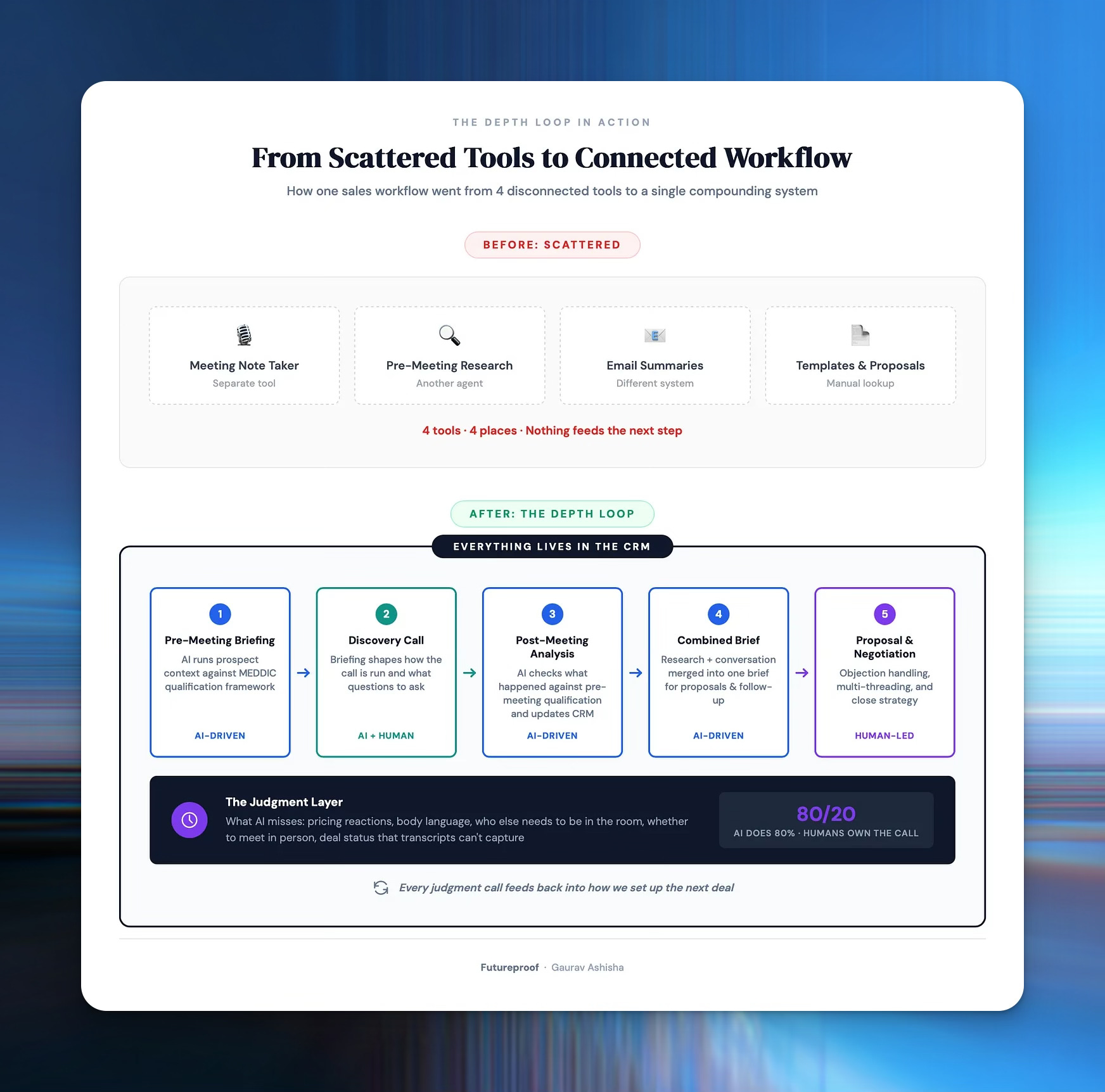
Step 1: We “Anchored” everything in the CRM. That’s where everything should connect. So we moved all AI workflows into the CRM.
Step 2: Then we could “map” how each sales stage actually impacts the next.
Pre-meeting research shapes how I run the discovery call.
The discovery call generates a qualification.
The qualification feeds the proposal.
The proposal informs how we handle objections and negotiate.
Step 3: Then we deepened. Instead of AI doing isolated tasks in separate tools, we built the whole workflow inside the CRM.
When a meeting is booked, AI runs the prospect’s context against our MEDDIC qualification framework and builds a briefing.
After the call, it checks what happened against that briefing, updates the CRM, and creates a combined brief that feeds straight into proposal creation and follow-up.
Step 4: I learned pretty quickly that AI misses things that matter. The text of a meeting might say one thing, but how the prospect reacted to pricing, their body language when you discussed the proof of concept — those cues don’t show up in a transcript yet.
We also started asking questions AI typically misses:
Do we need other people on the next call?
Should we meet in person?
Is multi-threading this deal the right move?
So we keep a rule. AI does 80% of the work. The final assessment of where a deal actually stands — that’s human. Always. And every time we make that judgment call, it feeds back into how we set up the next deal. That’s the loop.
The people and leaders who get the most from AI think of it as a connected system. Every tool and workflow feeds into the next.
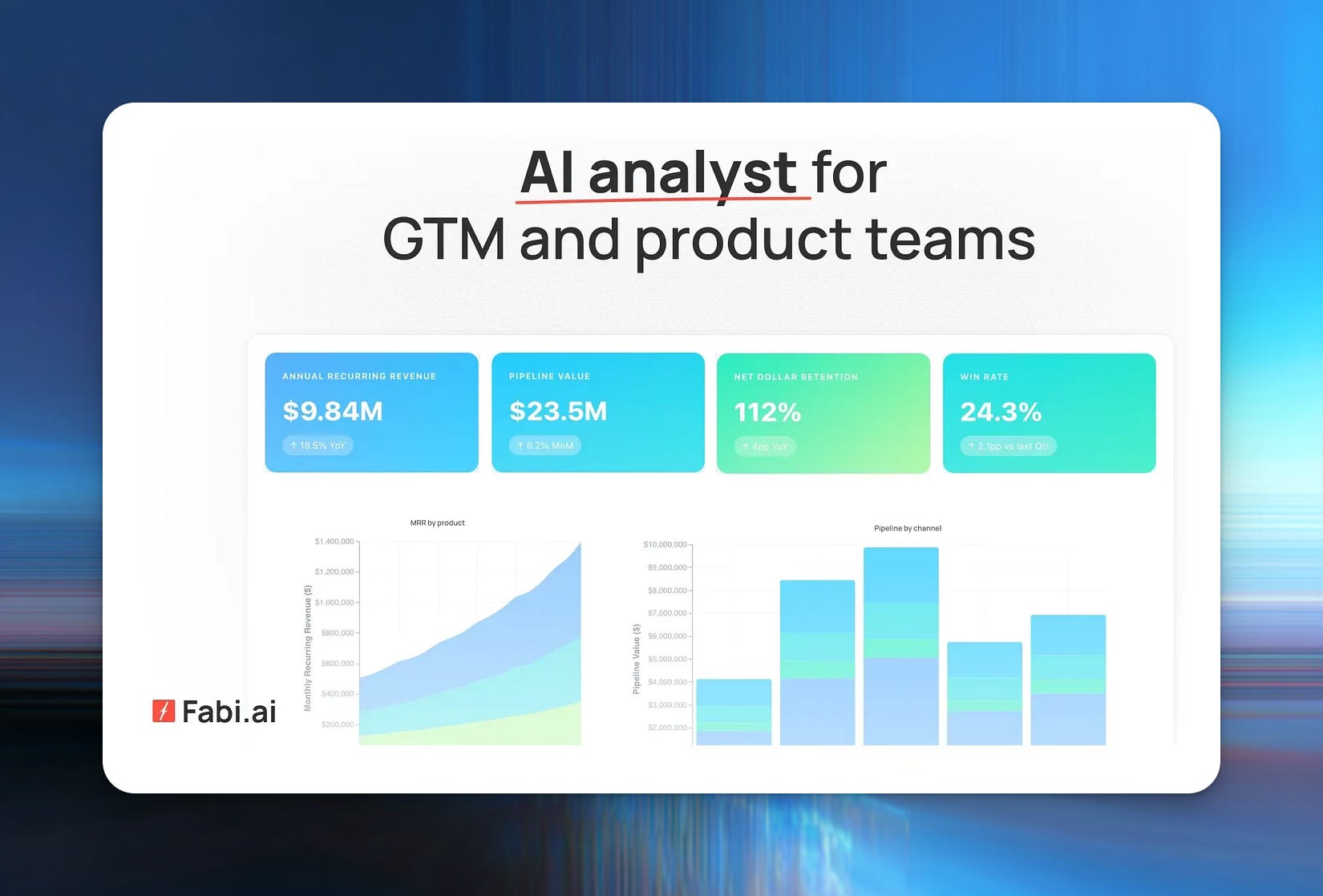
This is the same principle Fabi.ai uses to centralise data for teams like Go-to-Market, product, etc., to deeply understand what’s actually happening by connecting the entire stack and asking questions in plain English. Fabi will build full dashboards in minutes like the image below.
We know deep work compounds but why we go for shallow approach when it comes to AI
Shallow feels productive, and we’re wired for this feeling. Every small AI task we complete gives us a little dopamine hit. Draft an email in thirty seconds. Vibe code a tool. They all feel like progress.
But when we stay stuck on this small AI task loop, we start optimising for the feeling of productivity instead of real impact. We reach for the next quick AI task the same way we reach for the next scroll session on our phone.
You can see this at every level of AI use. Two people with identical Claude subscriptions.
One dumps a file into a project and types a quick prompt.
The other spends time structuring their project instructions, learning how Claude retrieves context, refining their approach over weeks until the tool genuinely transforms how they work.
It’s a same tool one gets a surface-level assistant. The other builds a thinking partner.
The people and leaders who run the AI Depth Loop will build something that’s genuinely theirs — a combination of domain knowledge and practiced judgment that nobody else has, because nobody else went deep in exactly the way they did.
AI removed the cost of building. It didn’t remove the cost of building the wrong thing.
The people who understand that difference are the ones who’ll be futureproof in their careers.
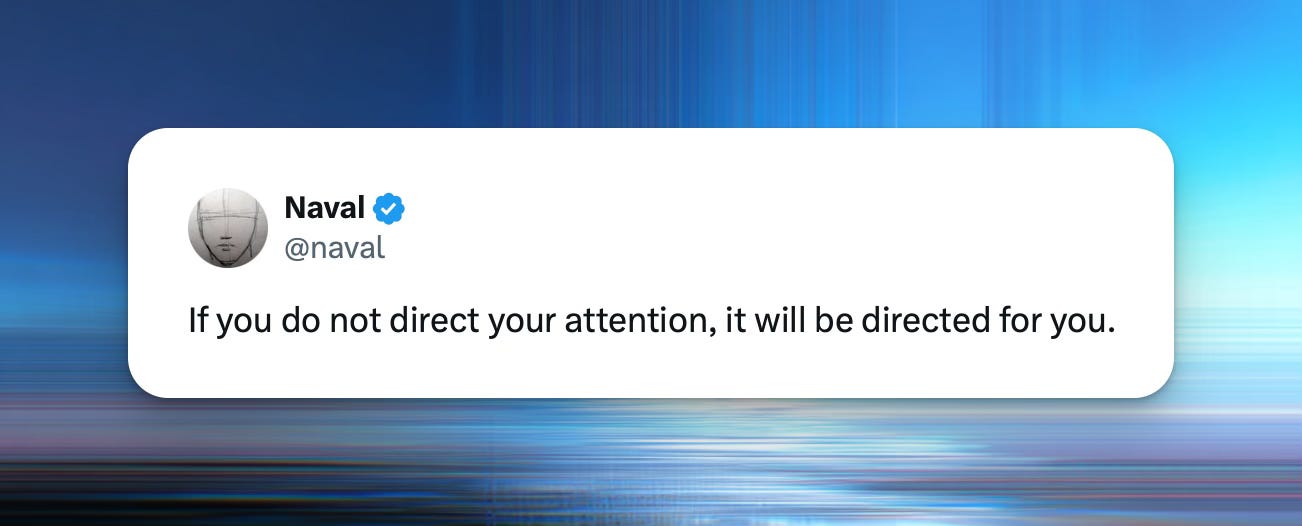
The quote that stuck with me this week
Stay curious,
Gaurav